
On automated and high-speed assembly lines, axial alignment is critical. A misaligned fastener can lead to cross-threading or complete joint failure—costing manufacturers significant time and money. To combat cross-threading and ensure straight entry into the nut member, standard fasteners often rely on an unthreaded point feature, commonly referred to as a dog point or pilot point.
However, while dog points work well to align traditional screws into tapped holes, dog points are not as effective for aligning TAPTITE® thread-rolling fasteners. Although TAPTITE® products eliminate cross threading problems, since they form mating threads upon installation, misalignment can still cause assembly problems such as excessive operator end load and/or higher thread-forming torque that impact joint integrity and performance.
In TAPTITE PRO® and TAPTITE 2000® fasteners (M6 and larger), these compromises are eliminated through a patented point geometry incorporating stabilizing threads.
The Problem with Traditional Dog Points
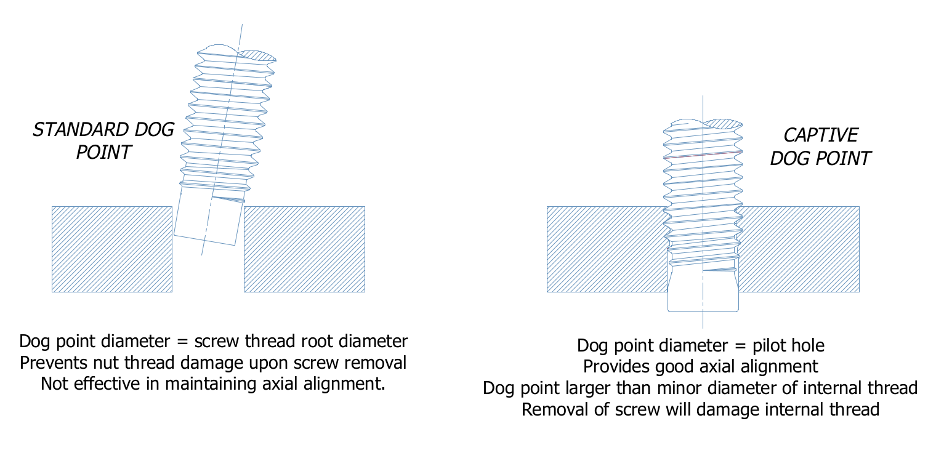
Conventional dog points are unthreaded pilot leads intended to guide the fastener into a hole before thread engagement begins. In practice, engineers face a classic trade-off between thread protection and alignment effectiveness:
- Standard Dog Point (Root Diameter): The pilot diameter is sized equal to the screw thread's root diameter. While this prevents damage to internal nut threads during screw removal, it leaves significant play in the hole. As a result, it is far less effective at maintaining axial alignment during initial driving.
- Captive Dog Point (Pilot Hole Diameter): The pilot diameter is enlarged to match the full pilot hole size to ensure tight axial alignment. The drawback? The dog point is larger than the minor diameter of the formed internal thread. Removing the fastener during service or repair can strip or ruin the internal mating threads.
The TAPTITE® Solution: Threaded Axial Alignment
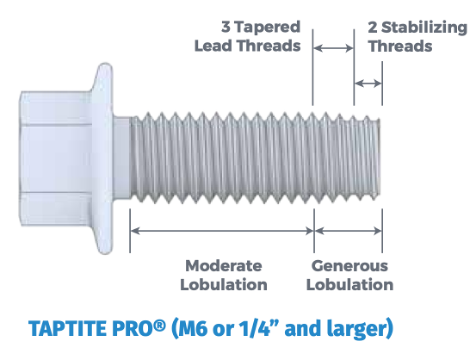
Rather than relying on unthreaded pilot pins, TAPTITE® fasteners for M6 and larger sizes utilize a 3-thread tapered lead paired with 2 stabilizing threads.
These stabilizing threads act as a "threaded dog point". They allow the fastener to locate the pilot hole smoothly, stand up straight, and self-align prior to thread-forming.
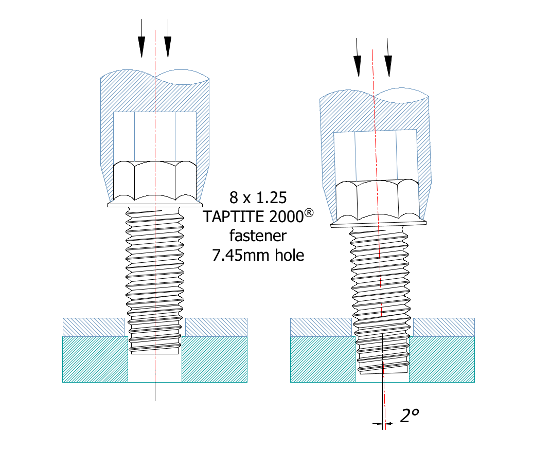
Key Advantages of Stabilizing Threads:
- Dramatic Reduction in End Load: Because the stabilizing threads align the fastener naturally within of the hole axis, minimal axial force ("end load") is needed to begin driving. For example, an M8 x 1.25 TAPTITE 2000® bolt requires only 10–20 N of end load to initiate thread forming—far below standard industrial limits (such as GM 6202M, which allows up to 90 N).
- Zero Internal Thread Damage: Unlike captive dog points, stabilizing threads carry the continuous thread profile. Removing the bolt for service or field repair poses no threat to the formed internal threads.
- Ergonomic and Robotic Efficiency: Lower end load requirements directly reduce operator fatigue on manual assembly lines and protect automated feed systems from high axial thrust loads.
- Superior Joint Performance: Straight entry ensures full, symmetrical thread engagement around the hole circumference, maximizing clamp load, axial pull-out resistance, and resistance to vibrational loosening.
The Bottom Line for Assembly Floor Performance
While conventional dog points force engineers to choose between easy removal and proper alignment, TAPTITE® stabilizing threads deliver both. By integrating alignment capability directly into the thread form, manufacturers achieve lower end loads, reduced line stoppages, and higher quality joints across all M6 and larger applications.
Interested in optimizing pilot hole parameters or reducing end load on your production line? Contact the REMINC/CONTI Engineering Team for customized joint analysis and testing data.